
The SCIF planning process can be complicated. Find out what information you will need to get your project started and avoid the common causes for delays.
Planning to build a SCIF (Sensitive Compartmented Information Facility) can be a complicated process. However, there is specific information clients can provide as that process begins to help make the experience as seamless, efficient, and on budget as possible.
To start, it is essential to know how a facility will need to function. This sounds simple, but many of the details involved aren’t always immediately clear. This blog will provide an overview of what basic information a client needs to share—and why those details are important—to start the SCIF planning process and to ensure that the quote they receive is accurate.

Collecting the right information before a SCIF construction project starts will help immensely with keeping your project on budget and on schedule. Photo: Canva Images
First Things First: Do You Actually Need a SCIF?
The SCIF planning process spans the moment a client first inquires about a bid through the submission of a SCIF design for approval by the project’s accrediting official (AO). In that initial bid conversation, the first question that will come up will be whether a SCIF is needed or if another facility may be a better fit for the project’s needs.
A SCIF is used for the storage or handling of sensitive information that the U.S. government classifies as top secret SCI (Sensitive Compartmented Information or SAP (Special Access Program. If a project involves the storage or handling of secret or confidential information, the classification level is lower and a SCIF is not needed; instead, a secret open storage room will suffice.
SCIFs and secret open storage rooms are built differently and have vastly different cost spreads. For these reasons, it is essential to nail down which facility is needed at the very beginning.
The Biggest Delay in SCIF Planning
The most common cause of delays in the SCIF planning process is a lack of information. Many clients will inquire about a bid before they have all of the information needed to produce an accurate quote. When this happens, assumptions may be drawn out of necessity to draft a bid, which can result in cost and timeline revisions when missing details are eventually filled in.
Planning first benefits everyone. This is especially true for commercial clients who may want to explore how much a SCIF will cost for a program they are bidding on but haven’t yet landed. It is possible to get a preliminary bid for these hypothetical projects. However, it is financially risky for a commercial client to enter into contract to build a SCIF before they are awarded the project and are in possession of both a DD Form 254 and an assigned AO.
What Information Is Needed: A SCIF Planning Checklist
SCIF planning is driven by—and often held up by a lack of—information. These are some of the details a client will need to provide to get the process started.
What size SCIF is needed?
How will the SCIF be used?
How many people will use the SCIF?
These details are often woven together. The size a SCIF needs to be may be dictated by how many people it needs to hold. For example, a SCIF serving as a workspace for 50 people will need more space than a SCIF that is only expected to be a briefing room for 10 people. While it is possible to accommodate varying size and usage requirements, these details are important to provide prior to the bid phase.
What are the SCIF’s TEMPEST requirements?
How many networks will the SCIF need?
Will the security systems need to be provided?
A project’s TEMPEST requirements will affect the materials used and overall cost of the SCIF. TEMPEST—the term used in reference to the investigation, research, and control of potentially compromising emanations that come from electronic devices—requirements include variables like RF (radio frequency) shielding, power filtering, grounding, and wave guides. The number of data networks and type of cabling required also impact the materials list and cost estimates, as does the question of whether the SCIF’s security systems will need to be provided.
Where is the SCIF going?
Does the SCIF’s intended destination need any improvements or upgrades?
Will any access concerns factor into delivery upon completion?
Building a SCIF is one thing; delivering and installing it is another. It is important to know whether the SCIF will be placed inside an existing building or outside in close proximity to other facilities. These variables impact the delivery process and factor into the facility’s security requirements. Knowing that a SCIF needs to be placed on a specific U.S. base is only part of the equation; knowing how much physical space is available for the facility and its security perimeter is the other.
In preliminary bid conversations, other details—covering city and/or county permitting requirements, anticipated SCIF access by the general public, and any interior furnishing needs—will also come up. The more of these details a client can provide at the beginning, the faster and more accurate the planning process will be.
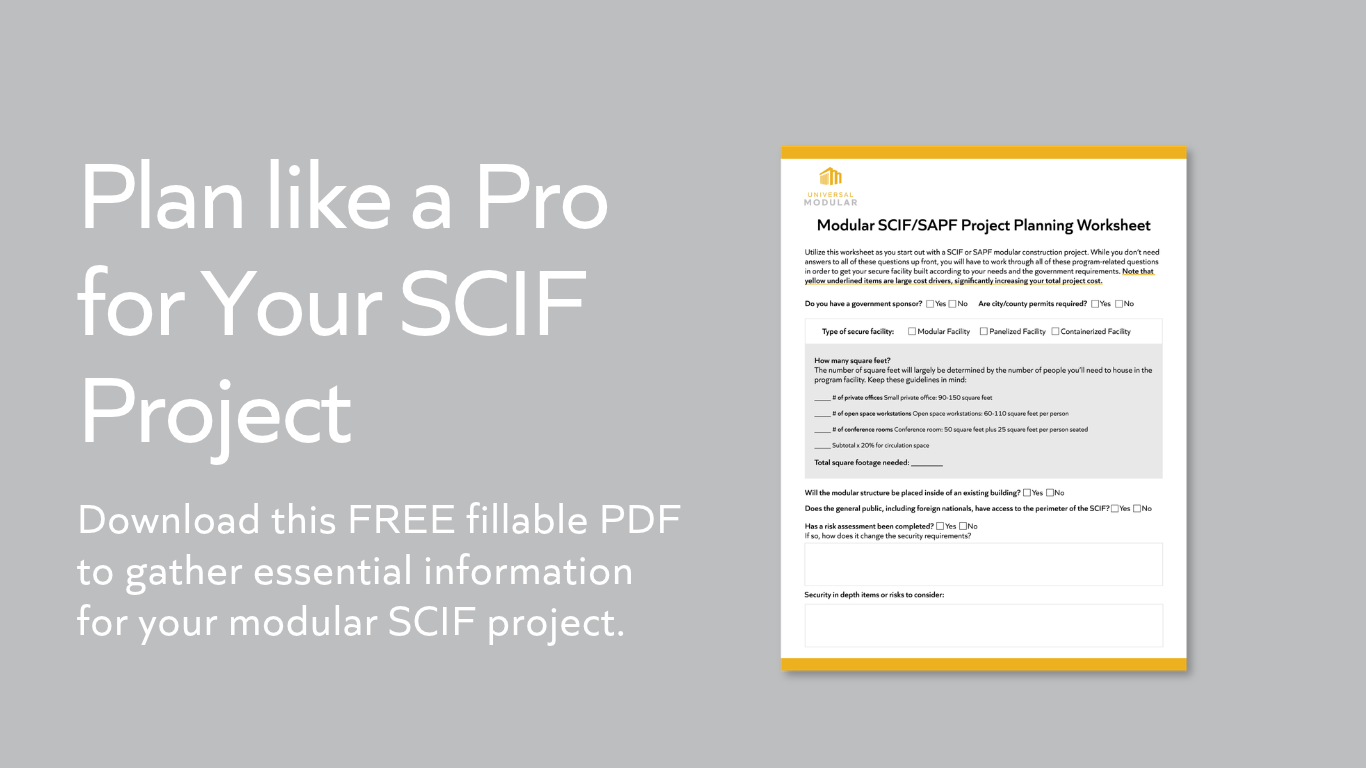
All Stakeholders Must Be Involved
One of the simplest ways to avoid SCIF planning delays and ensure that all of the necessary information is clear from the beginning is to make sure each of the project’s stakeholders—from the person paying for the facility and the security team to the facilities department and the end user—are on the same page. Planning in a bubble doesn’t work because it leads to delays and missed details.
The most successful projects are the ones that embrace the “slow down to go fast” concept, where every stakeholder involved takes a moment to pause at the beginning so that they can clearly communicate what they need and want from the SCIF. Think of it like putting together a puzzle: If you lay out all of the pieces at the beginning, it’s much easier to complete the picture than when missing pieces are added to the pile over time.
Don’t Hesitate to Reach Out With Questions
Providing as much information as possible from the get-go is vital to receive an accurate quote and start the SCIF planning process. If a client isn’t sure whether they have all of the necessary information—or are unsure about which questions to ask—it can be helpful to talk it through with an expert.
An introductory discussion via phone can help save time, avoid misunderstandings, and illuminate which details you may be missing. Contact Universal Modular Inc. today to get the SCIF planning process started.