
Standard ISO shipping containers are often transformed into ICD 705-compliant container SCIFs. But there are cost and space limitations to consider.
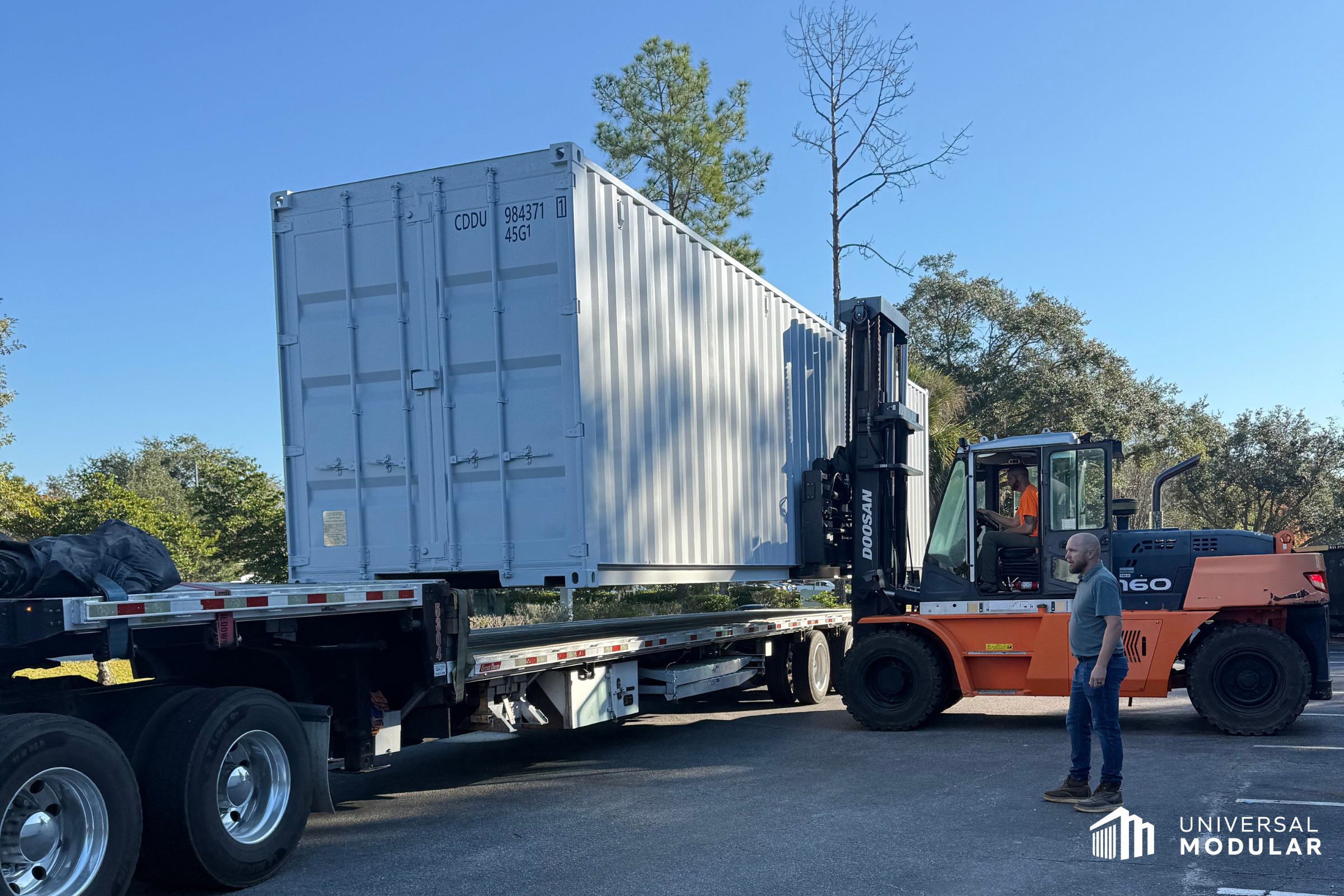
ISO shipping containers offer a variety of advantages when being converted to secure facilities, including transportability and speed.
When you see an empty shipping container, your first thought might not be that it could become a modular SCIF (Sensitive Compartmented Information Facility) or SAPF (Special Access Program Facility).
However, modular construction companies often transform shipping containers—both those that have been used before and those that haven’t—into secure facilities that are fully ICD 705 compliant. While there are many benefits of choosing shipping containers for these kinds of projects, it’s important to keep your budget in mind because the cost of renovating an existing space is almost always less than what it’ll cost to buy a container SCIF.
The Advantages of Converting Shipping Containers
Time is perhaps the main benefit of forgoing traditional construction and instead converting an ISO (International Organization for Standardization) shipping container into a container SCIF. Because modular construction companies generally aren’t juggling permitting timelines or landlord-related hold-ups, they can fabricate the facility faster than a contractor can build it.
Fabricating a container SCIF in a factory setting means that there are no construction-related disruptions to the space where the facility will ultimately live. It also means that there is a much higher product quality and consistency than there would be for a typical construction project.
The Disadvantages of Converting Shipping Containers
Cost, however, is important to keep in mind. Converting a shipping container into a container SCIF is more expensive than renovating an existing space.
While existing buildings already have HVAC and electrical systems that only need modifications to meet ICD 705 requirements, both of these systems will need to be added to a shipping container. A budget for a container SCIF must also factor in transporting the facility from the factory to its final destination—a cost that isn’t incurred when an existing space is modified.
Shipping container space limitations may also give some clients pause. While standard ISO shipping containers can be 10, 20 or 40 feet in length, they are only 8 feet wide with a height of either 8.5 or 9.5 feet. This restricts the kinds of workspaces that can be created inside.
How a Shipping Container Becomes a SCIF or SAPF
Simply put, a modular construction company will begin with a standard 10-, 20- or 40-foot ISO shipping container and build it according to the project’s ICD 705 requirements.
But what exactly does that process look like?
First, a Construction Security Plan (CSP) is written, just as it would be for a standard fixed facility. The contractor also provides a pre-Fixed Facilities Checklist (FFC) for the customer to complete at the onset of the project. A Transportation Security Plan (TSP), which ensures the security of a modular SCIF when it is moved to its final location, is also drafted.
Once the empty shipping container arrives at the factory, the exterior is typically prepared first for repainting. Full sound-rated and RF-shielded floor, wall, and ceiling systems are installed next. Almost all of the products are the same as those that would be used for a conventional construction project.
The modified shipping container will also be outfitted with the facility’s specific needs, which may include installing data racks or bringing in desks and furniture.
Throughout the fabrication process, the CSP is closely followed. As with standard fixed facilities, all checklists are followed to the letter, and photo documentation occurs at every step.
Meeting RF Shielding Requirements
All shipping containers can be fabricated to meet a project’s ICD 705 requirements.
At Universal Modular Inc., all container SCIFs are built to exceed 100 dB of RF shielding. This is achieved by installing waveguides at all penetrations, using honeycomb filters for HVAC air exchange, and using power filtering or data filtering, if required.
ICD 705-compliant doors and hardware are installed, all conduit is surface-mounted, and fire sprinklers with dielectric brakes can be added if necessary. If a project has any other specialty requirements, those will be met.
The Accreditation Process
Your modular construction team will assist throughout the facility’s accreditation process—including with final documentation.
Having expert eyes on these documents—not to mention the entire build process—will help ensure the accuracy of the modular SCIF’s accreditation documentation. Submitting pristine documentation to your Accrediting Official (AO) helps move the process along.
How Long Does the Process Take?
The biggest hurdle is getting your AO to sign off on the container SCIF’s design, a process that can take anywhere from 60 to 180 days. Approval must be granted before fabrication can begin.
In addition to signing off on the design, the AO must review and approve the facility’s TSP. If any issues arise during the build process, the AO must be brought into the loop immediately or else the container SCIF could risk losing its chance at accreditation.
A modular construction team will typically need 8–10 weeks to fabricate a facility once its design is complete and the AO has approved it, though this estimate can shift if a project is more complex.
At the very end of the process, the AO will be the one to sign off on the container SCIF’s accreditation—assuming it meets all ICD 705 requirements—after fabrication is complete and it has been transported to its final destination.
With AO approval timing factored in, it can take anywhere from 7–12 months to complete a project.
Are These Facilities T-SCIFs?
One of the most common questions clients have is whether shipping containers that become SCIFs are T-SCIFs, also known as temporary facilities.
The simple answer is: no. While a client may choose to accredit their completed facility as a T-SCIF, T-SCIF requirements aren’t as stringent as those set out for container SCIFs. Each container SCIF built by UMI is fabricated to meet or exceed the ICD 705 requirements of a fixed facility.
Contact UMI today to get a quote for a container SCIF.